
If you’re wondering how to remove stains from granite countertops, the good news is that most stains can be removed without damaging the stone—as long as you use the right method. Granite is one of the toughest countertop materials available, but because it’s a natural stone, it can absorb liquids if spills are left sitting too long or if the sealant has worn away.
For over three decades, Cosmos Marble & Granite has guided homeowners throughout Huntingdon Valley and the Metro Philadelphia area in selecting, installing and maintaining beautiful natural stone countertops. Now the good news is that granite can look as spectacular years down the line as it did on installation day – if it’s cleaned correctly!
Key Takeaways
- Most granite stains can be removed if treated with the correct cleaning method.
- Different stains require different solutions—oil, coffee, wine, and rust should not all be treated the same way.
- Avoid harsh household cleaners that can damage granite’s protective seal.
- Resealing granite regularly helps prevent future stains.
- Professional stone experts can restore granite that DIY methods can’t safely fix.
Why Does Granite Stain?
Let’s cut to the chase. Granite is tough and less scratch resistant but it can stain.
Granite contains tiny natural pores. The sealer fills those pores, so it’s much less possible that a liquid really penetrates. As the solvent is extinguished, oils, wine, coffee cooking grease something juice and even cosmetics are going to invade
The sooner you clean up a spill the better off you will be.
Common Types of Granite Stains
When you know what the stain is, that helps your approach to cleaning it.
Oil and Grease Stains
These usually appear in dark spots.
Common causes include:
- Cooking oil
- Butter
- Grease
- Lotion
- Cosmetics
Regular soap does not work as oil gets into the pores.
Organic Stains
Organic stains often come from:
- Coffee
- Tea
- Wine
- Fruit juice
- Food spills
Most disappear leaving brown, pink or reddish spots.
Hard Water Deposits
Mineral deposits, which can manifest in the form of white or slightly cloudy spots on granite when water continually collects around your faucet.
Rust Stains
Rust spots from copper pans, or even other links like metal cans, cast iron cookware or wet steel utensils on the flooring.
Best Way to Clean and Remove Stains From Granite Countertops
Stain removal isn’t a one-size-fits-all.
Start With Gentle Cleaning
Before trying anything stronger:
Wipe away loose debris.
Ensure to wash the region with lukewarm water.
Add a few drops of mild dish soap.
Dry thoroughly, using a microfiber cloth.
However, sometimes that stain just sits on the top.
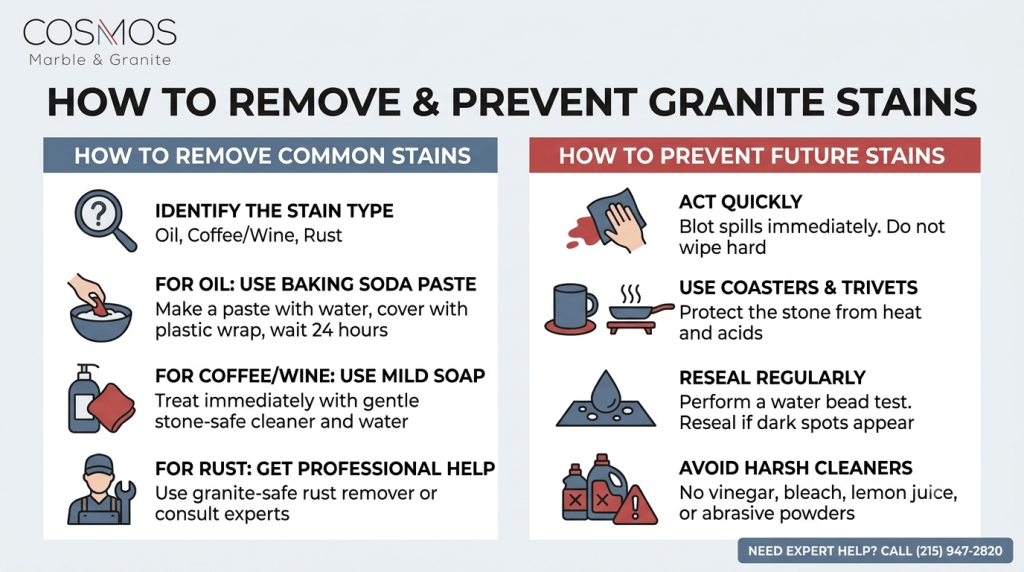
Poultice With Baking Soda to Remove Oil Stains
On some more serious grease and oil stains, a poultice is occasionally required.
You’ll need:
- Baking soda
- Water
- Plastic wrap
You then mix baking soda with water to form a good thick mixture.
Then:
How to apply the paste onto the stain
Cover it with plastic wrap.
Tape down the edges.
Leave it for about 24 hours.
Remove the paste.
Rinse thoroughly.
Unlike cleaning hides merely surface dried, the poultice pulls oil from the granite pores. If you have an older stain, it might require several treatments.
Remove Coffee or Wine Stains
However, a baking soda poultice is great for coffee and grape/wine stains. A handful of stone care experts suggested including a couple drops of hydrogen peroxide for light granite—when blotting incredibly stubborn natural stains—but ought to be examined in an inconspicuous place first.
Do not ever pour bleach on granite directly.
Clean Hard Water Spots
This means that mineral deposits usually sit on the surface instead of having penetrated into the stone.
Use:
- Warm water
- Stone-safe cleaner
- Soft microfiber cloth
Don’t scrub hard, because hard abrasives can damage polished finishes.
Treat Rust Carefully
Rust is one of the most challenging stains to remove.
Skip homemade acidic cleaners. If you have constant sediment or discoloration from stains, use a rust remover that is safe to apply on granite and other natural stone surfaces or hire a stone restoration company.
What Cleaners Should NOT Be Used?
It is here where many homeowners accidentally inflict irreversible harm.
Avoid using:
- Vinegar
- Lemon juice
- Ammonia
- Bleach
- Abrasive powders
- Steel wool
- Scouring pads
- Magic Erasers on polished stone
Eventually, these products will remove the protective seal or dull the clear finish.
How to Prevent Granite Stains
Related: It is much easier to clean rather than removing the stains.
Habits that you would want to follow:
Clean Spills Immediately
Oil, wine, tomato sauce, coffee and juice is not ever to be sat for hours.
Blot first.
DO NOT wipe super hard and create a mess
Use Trivets and Coasters
Granite performs great with heat, but you want to use trivets and coasters to protect the stone and sealant.
Use Stone-Safe Cleaners
For routine use a simple pH-neutral granite cleaner is usually fine.
Reseal the Countertops
Granite should be resealed on a regular basis, but this does depend on what type of granite you have and how much you use your kitchen.
A quick water test can help:
Simply apply a couple of droplets of water on the surface area.
Wait several minutes.
If it darkens, this is sign that the stone needs to be re-sealed.
When DIY Methods Aren’t Enough
Because in some instances those stains are weeks — and even months old.
For deep oil set-in’s, rust or damaged sealers, you might need a pro to deeply restore than rely on a DIY paste.
And this is where Cosmos Marble & Granite can help.
Our experienced staff doesn’t just create and install countertops. And we educate homeowners about how to care for their stone properly as they learn — arming them with the tools they need to help protect their investment well into the future! We are a family owned and operated business in Huntingdon Valley, having spent almost 30 years helping customers across Metro Philadelphia with the natural & engineered stone surfaces of their dreams.
 Get Your Free Countertop Consultation
How To Get Stains Out of a Countertop Made Of Granite By Replacing The Counter?
Usually, no.
With the proper treatment, most stains are removed or greatly improved.
In general you will only need to replace if:
The stone has cracked.
Yet has significant structural damage on the exterior.
Previous repairs were unsuccessful.
The surface has deep etches, or discoloration to the point of no repair.
Prior to suggesting replacement, a stone professional will assess the stone and find a solution that is best for saving value.
However, this makes a difference when you have professional granite care.
Online cleaning tips are everywhere.
The catch, a lot of this doesn’t even apply to granite.
Natural stone is not the same from slab to slab. Just because a product works on one style of counter top does not mean it will now ruin another! These professionals are experts in the care and cleaning of all different types of stone and know how certain colors, finishes and sealers react to particular cleaning processes.
Cosmos Marble & Granite combines decades of craftsmanship with the latest high-tech fabrication technology to bring you beautifully-crafted countertops, complimented with care tips. It means fewer costly mistakes and surfaces that will appear new for years to come.
Conclusion
The first step to learning how to remove stains from granite countertops lies in recognizing the type of stain and using the correct cleaning method. In most cases, gentle cleaners and baking soda poultices, quick spill cleanup, and a periodic sealing will serve to keep granite looking great. Steer clear of abrasive tools and harsh chemicals that will cause permanent damage to your stones.
If your granite countertops have stubborn stains or you’re planning a new kitchen project, Cosmos Marble & Granite is here to help. Our experienced team proudly serves homeowners throughout Huntingdon Valley and the Metro Philadelphia area with expert countertop design, fabrication, installation, and long-term care guidance. Contact Cosmos Marble & Granite today to keep your natural stone looking its best.
Get Your Free Countertop ConsultationFrequently Asked Questions
Q: Can baking soda damage granite countertops?
A: No. Baking soda is generally safe when used occasionally as a poultice for stain removal, but it shouldn’t replace your regular granite cleaner.
Q: Can I use vinegar on granite countertops?
A: No. Vinegar is acidic and may weaken the protective seal over time, increasing the risk of stains and dullness.
Q: How long should a baking soda poultice stay on granite?
A: Most professionals recommend leaving it covered for about 24 hours before removing it. Older stains may require multiple applications.
Q: How often should granite countertops be sealed?
A: Many granite countertops benefit from resealing every one to three years, depending on the stone and how frequently it’s used.
Q: Can old granite stains be removed?
A: Yes. Many older stains can still be reduced or removed using the appropriate poultice or professional stone restoration methods, although results vary depending on how deeply the stain has penetrated.